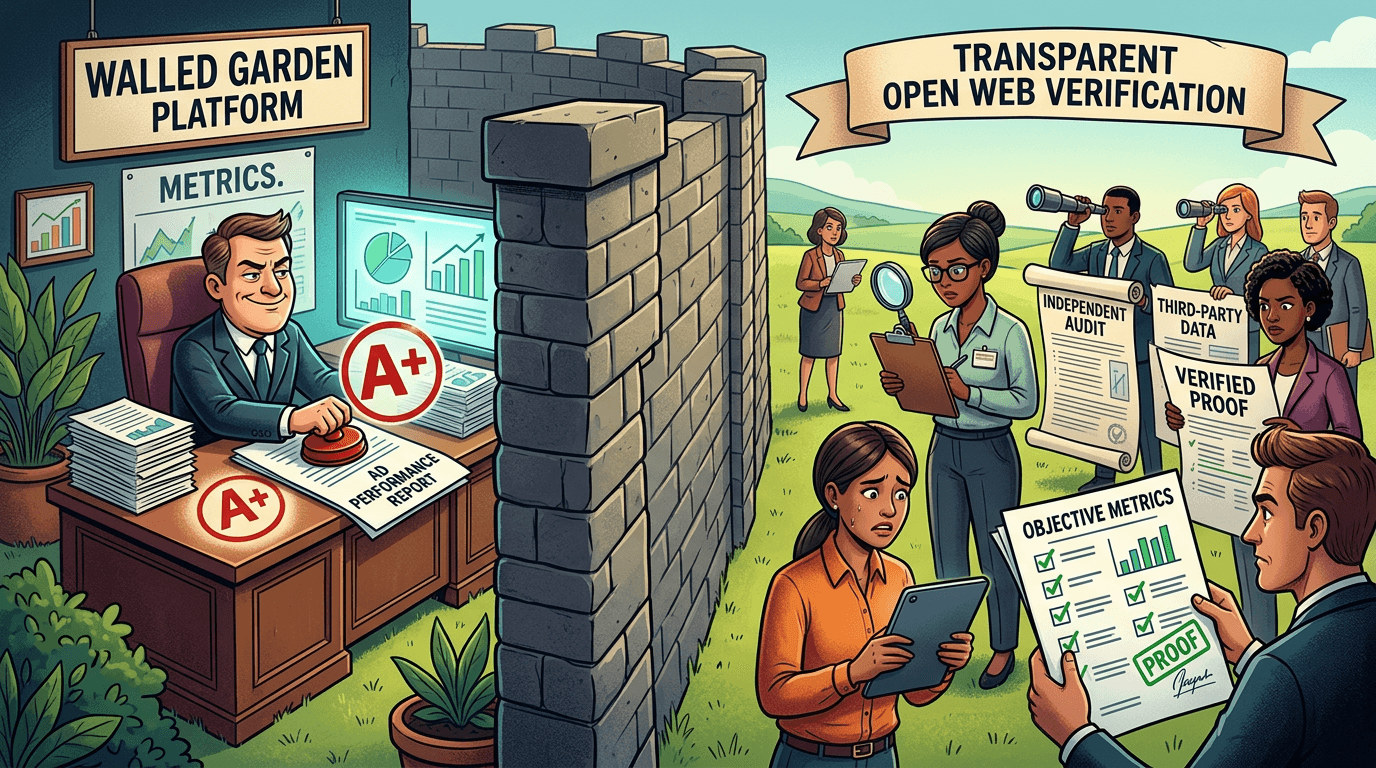
Imagine hiring a contractor to renovate your kitchen. They pick the materials, do the work, and then hand you a report card they wrote themselves saying everything looks great. You never get to inspect the cabinets. You never see the receipts. You just have to trust them.
That’s how advertising works inside a walled garden.
The Walled Garden Problem
A walled garden is a closed ecosystem where a single company controls the ad server, the exchange, the measurement tools, and the content. Google owns Ad Manager, AdX, DV360, Campaign Manager 360, Google Analytics, and YouTube. Meta controls the ad platform, the targeting data, and the reporting across Facebook and Instagram. Amazon runs the marketplace, the DSP, and the attribution—all under one roof.
When you buy ads inside a walled garden, you’re trusting the same company to place the ads, count the impressions, measure the performance, and report the results—all without any independent checks. It’s like letting the student grade their own exam.
What Advertisers Actually Deserve
Every advertiser—whether spending $50,000 or $50 million—deserves three things:
- Verification that their ads were actually seen by real people
- Full ownership of their campaign data, not a filtered summary from the platform that sold the media
- Transparent pricing that shows exactly where every dollar goes
Inside a walled garden, you get none of these. The platform’s reporting tells you what the platform wants you to know. Third-party verification providers like IAS, DoubleVerify, and Oracle Moat have limited access inside these ecosystems, if they’re allowed in at all.
How the Open Web Works Differently
The open web is the opposite of a walled garden. Instead of one company controlling everything, the ecosystem is built on independent, interoperable layers:
| Layer | Walled Garden | Open Web |
|---|---|---|
| Ad Serving | Platform-owned ad server | Independent DSPs (Blockboard, The Trade Desk, etc.) |
| Verification | Platform’s own metrics | Third-party (IAS, DoubleVerify, Oracle Moat, Blockify™) |
| Data Ownership | Platform-controlled | Advertiser-owned, portable |
| Inventory | Platform-owned properties only | CTV, audio, display, DOOH across 100K+ publishers |
| Pricing | Bundled, opaque fees | Transparent CPM with visible tech fees |
On the open web, every participant in the supply chain can be independently audited. The platform serving the ad is not the same entity measuring its performance. That separation is the foundation of trust.
The Inventory Advantage
Walled gardens limit you to their own properties. Each one gives you access to its owned-and-operated inventory—and nothing else.
The open web gives you access to everything else—and that “everything else” is enormous:
- Connected TV (CTV): Hulu, Peacock, Tubi, Pluto TV, and thousands of streaming apps across Roku, Fire TV, Apple TV, and Samsung TV Plus
- Digital audio: Spotify, Pandora, iHeart, SiriusXM, and podcast networks
- Premium display: News publishers, sports sites, lifestyle magazines, and niche verticals
- Digital out-of-home (DOOH): Billboards, transit screens, and retail media
When your audience is watching a Peacock original, listening to a Spotify playlist, or reading the Wall Street Journal—they’re on the open web. A walled garden can’t reach them there.
The Fraud Question
One argument for walled gardens is safety: “The ecosystem is more controlled, so there’s less fraud.” But controlled by whom? And verified by whom?
Walled gardens have faced repeated scrutiny over ad fraud within their own networks. A 2023 Adalytics report found that ads purchased through a major walled garden were being served on muted, auto-playing, out-of-view placements—and the platform was still charging for them as “viewed.”
The safest environment isn’t the one with the biggest walls—it’s the one with the best locks. Verification is the lock.
On the open web, fraud detection is handled by independent third parties who have no financial incentive to inflate numbers. Blockboard goes further with Blockify™, our proprietary blockchain-verified impression tracking that creates an immutable record of every ad served.
What This Means for Your Budget
Every dollar spent inside a walled garden is a dollar you can’t fully account for. These platforms bundle their tech fees into CPMs, making it nearly impossible to see how much of your budget goes to actual media versus platform costs.
On the open web, pricing is transparent. At Blockboard, our clients see exactly what they pay for media, what goes to data, and what our platform fee is. No bundled margins. No hidden take rates.
The Path Forward
The advertising industry is at an inflection point. Privacy regulations are tightening. Third-party cookies are disappearing. Advertisers are demanding accountability. The brands that thrive in this new landscape will be the ones that insist on verification, transparent pricing, and full data ownership.
Walled gardens will keep building higher walls. The open web will keep building better windows.
The question for every advertiser is simple: do you want to trust the platform that profits from your spend to also grade its own work? Or do you want proof?
Blockboard is an AI-powered, blockchain-verified programmatic advertising platform built on the open web. We help brands reach audiences across CTV, audio, display, and DOOH with full transparency and verification. Request a demo to see the difference.